
Bass Tabs Easy
Bass tab is the fastest way to start playing: four lines for the four strings, numbers for the frets. These ten easy exercises cover the patterns most songs are built on, and the tab maker lets you write your own lines, hear them played back at any tempo and print them.
- Free to use
- No sign-up
- Runs in your browser
Bass tab maker and player
Fretboard note finder
Easy Bass Tab Practice Pack
Printable tabs of the ten beginner exercises, blank 4-string bass tab paper, a fretboard note chart and a practice log with tempo targets.
- Ten exercises (PDF)
- Blank tab paper (PDF)
- Fretboard chart (PDF)
- Practice log (PDF/DOCX/XLSX)
Formats: PDF, DOCX, XLSX. Instant download after payment (link valid 72 hours, up to 5 downloads). AI-assisted: the templates were drafted with AI help and reviewed and laid out before publishing.
$5.00 USD, one-time 4 files · about $1.25 each
- Instant download
- 7-day refund
- Secure checkout by Stripe
7-day money-back guarantee. Full refund within 7 days of purchase, even after you download.
Free sample: Bass Fretboard Chart (PDF, 57 KB)
Full refund within 7 days — see the refund policy and license.
Free printables
Single sheets you can print right now, no sign-up. The full pack adds every sheet in one download plus the editable files.
 Printable Bass Practice Log
How to read bass tab
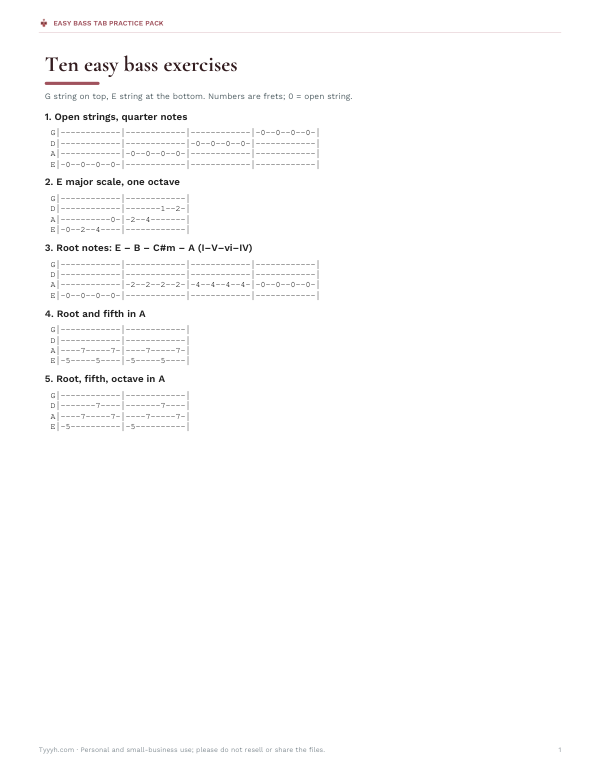
Bass tab has four lines, one for each string. The top line is the thinnest string, G, and the bottom line is the thickest, E — the same way you look down at the neck while playing. A number on a line tells you which fret to press on that string; 0 means play the string open. Numbers are read left to right. Vertical bars mark bar lines. Tab doesn’t show rhythm exactly, so listen to the recording or use the playback in the tab maker to hear the timing.
The ten exercises
| Exercise | What it teaches |
|---|---|
| Open strings | Plucking evenly with alternating fingers |
| E major scale | Fretting-hand shape across three strings |
| Root notes I–V–vi–IV | Following chord changes — the basis of countless songs |
| Root and fifth | The most common bass movement |
| Root, fifth, octave | A shape you can move anywhere on the neck |
| Blues boogie line | A classic 12-bar blues pattern |
| Octaves | Disco and dance grooves |
| Chromatic warm-up | Finger independence and accuracy |
| Minor pentatonic | Fills and riffs in rock and blues |
| Walking line | Moving between chords in jazz and swing |
All exercises are original teaching patterns, free to use and share.
Exercise tabs
| Exercise | Notes (string + fret) |
|---|---|
| 1. Open strings, quarter notes | E0 E0 E0 E0 | A0 A0 A0 A0 | D0 D0 D0 D0 | G0 G0 G0 G0 |
| 2. E major scale, one octave | E0 E2 E4 A0 | A2 A4 D1 D2 |
| 3. Root notes: E – B – C#m – A (I–V–vi–IV) | E0 E0 E0 E0 | A2 A2 A2 A2 | A4 A4 A4 A4 | A0 A0 A0 A0 |
| 4. Root and fifth in A | E5 A7 E5 A7 | E5 A7 E5 A7 |
| 5. Root, fifth, octave in A | E5 A7 D7 A7 | E5 A7 D7 A7 |
| 6. Blues boogie line: A bar and D bar | E5 A4 A7 A9 A10 A9 A7 A4 | A5 D4 D7 D9 D10 D9 D7 D4 |
| 7. Octave pattern on G (eighth notes) | E3 D5 E3 D5 E3 D5 E3 D5 |
| 8. Chromatic warm-up, fingers 1-2-3-4 | E1 E2 E3 E4 | A1 A2 A3 A4 | D1 D2 D3 D4 | G1 G2 G3 G4 |
| 9. A minor pentatonic | E5 E8 A5 A7 | D5 D7 G5 G7 |
| 10. Walking bass: Dm7 – G7 – Cmaj7 | A5 D3 D7 D10 | E3 A2 A5 D3 | A3 D2 D5 G4 |
Load any exercise into the tab maker above to see it as a full tab and hear it at your chosen tempo.
Worked example
A new player loads exercise 3, the root notes for E – B – C#m – A. The tab shows four E-string 0s, then four 2s and four 4s on the A string, then four A-string 0s. At 70 BPM it’s easy to count “1, 2, 3, 4” for each chord. After a few minutes they set the tempo to 90 and then transpose by +2 semitones — the pattern moves to F# – C# – D#m – B — to play along with a song in a different key.
Building a practice routine
| Minutes | Activity |
|---|---|
| 3 | Warm up with the chromatic exercise at a slow tempo |
| 4 | Scale or pentatonic pattern, up and down |
| 4 | Root notes or root–fifth along with a chord progression |
| 4 | Play along with a song you like, even if only the root notes |
Fifteen focused minutes a day beats an occasional long session. Note your clean tempo for each exercise in the practice log and raise it by a few BPM when it feels easy.
Tips for beginners
- Pluck with your index and middle fingers alternately.
- Press just behind the fret wire, not on top of it.
- Use one finger per fret in a four-fret span.
- Mute strings you aren’t playing with the side of your plucking finger or thumb.
- Practise slowly with a metronome, then speed up a few BPM at a time.
- Keep sessions short and regular — 15 minutes a day builds calluses and muscle memory.
Fretboard notes
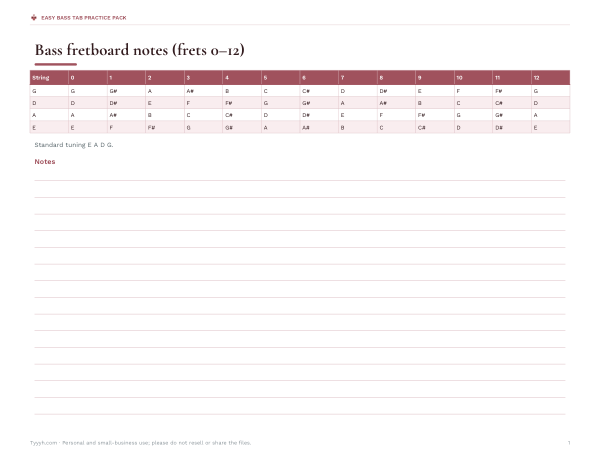
The open strings, from lowest to highest, are E, A, D and G — the same as the lowest four strings of a guitar, an octave lower. Each fret raises the pitch by a semitone, and the 12th fret is an octave above the open string. Use the note finder to see every place a note appears in the first 12 frets: finding the same note on two strings is the key to playing patterns in comfortable positions.
Privacy
Tabs and playback are created in your browser.
Frequently asked questions
How do you read bass tabs?
Each line is a string (G at the top, E at the bottom); numbers are the frets to press.
What are the strings on a bass?
E, A, D and G from lowest to highest on a standard 4-string bass.
What is the easiest bass pattern?
Playing root notes of the chords in steady quarter or eighth notes.
Can I hear the tab?
Yes — press Play to hear a synthesised bass at your chosen tempo.
Does tab show rhythm?
Not precisely; listen to the music or use playback to hear timing.
Are these song tabs?
No — they are original exercises based on common patterns.
Should I learn tab or standard notation?
Tab is quickest for starting; learning notation later helps with reading rhythm and playing in bands and ensembles.
Can I use these exercises on a 5-string bass?
Yes — the lowest four strings match; the extra low B string isn’t used.